GPT-4 system card: the 8k price, the 32k window, and the bar exam
GPT-4 launched 14 March 2023 at $30 per million input tokens for an 8,192 context. What the system card admits, priced against the 32k window.
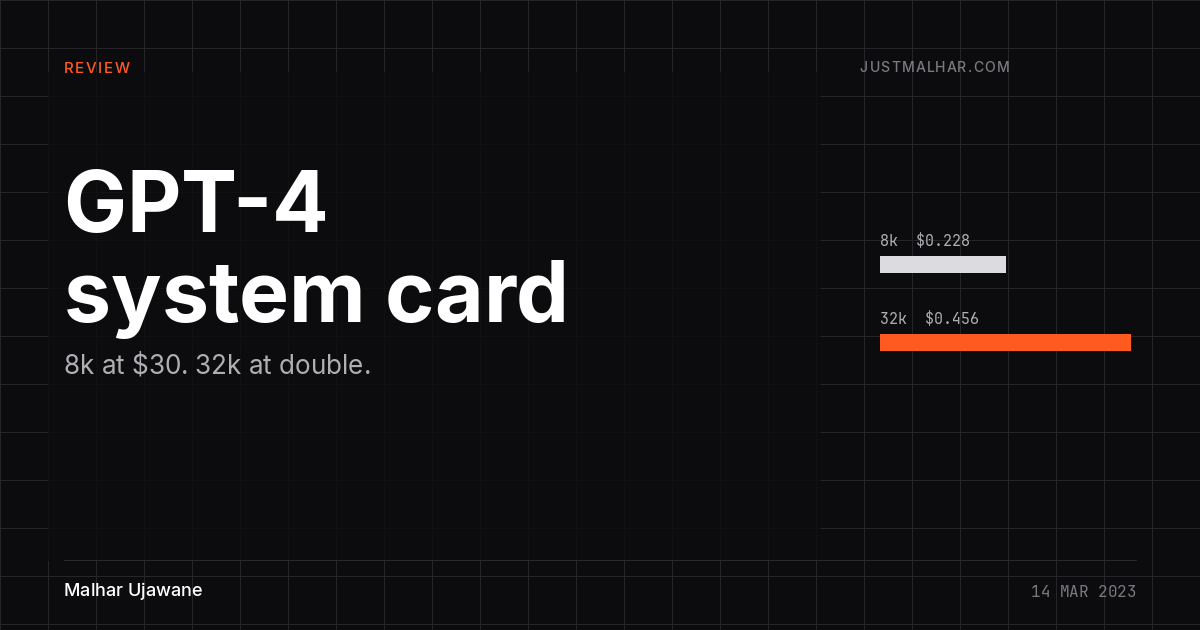
GPT-4 came out on 14 March 2023 at $30 per million input tokens and $60 per million output tokens for an 8,192-token context. A 32,768-token model is on limited access at double those rates. The system card dated March 2023 is the other document from the same release, and it is the one I would make a reviewer read. The bar-exam line is a percentile. The card is the list of failures a pilot still has to test.
OpenAI describes a multimodal model: image and text in, text out. They say it is less capable than humans in many real-world settings, and human-level on various professional and academic benchmarks. On a simulated bar exam they place it around the top 10% of test takers. They place GPT-3.5 around the bottom 10%. That spread is the sentence that will travel. The card should travel with it.
What shipped on 14 March 2023?
The API uses the same Chat Completions shape as gpt-3.5-turbo. Access is a waitlist. Requests at launch are text-only. Image inputs are in a limited alpha. The research post leads with images. The call a waitlisted developer can make this week sends text and receives text.
gpt-4 tracks the recommended snapshot. Pin gpt-4-0314 to hold this week’s weights. OpenAI says that snapshot is supported until 14 June 2023. Context is 8,192 tokens. Default limits are 40k tokens per minute and 200 requests per minute.
gpt-4-32k is limited access. OpenAI describes the window as about 50 pages. Pin gpt-4-32k-0314, also supported until 14 June 2023. The rates are $0.06 per 1K prompt tokens and $0.12 per 1K completion tokens, $60 and $120 per million, double the 8k rates of $0.03 and $0.06 per 1K, or $30 and $60 per million. They say long-context quality is still being improved. I would file that sentence with the price: double per token, on a window they are still tuning, for accounts that have been let in.
Training finished in August 2022. The card describes two stages: next-word prediction, then RLHF. Six months of iterative alignment followed, using adversarial testing and lessons from ChatGPT. The research post calls the outcome the best yet on factuality, steerability, and staying inside guardrails, “though far from perfect.”
ChatGPT, the free research preview of 30 November 2022, is a sibling of InstructGPT and the public place those lessons were learned. I wrote the day-one limits up in ChatGPT research preview: plausible-sounding incorrect or nonsensical answers, sensitivity to phrasing, verbosity, guessing instead of a clarifying question, and uneven refusals. GPT-4’s card is the next document in that sequence. It names two training stages, next-word prediction and then RLHF, and it writes the risks down. The dollar rate sits on the launch post beside the card.
What does one call cost on the 8k model and the 32k model?
The call is hypothetical. The prices are the launch post. I used 6,000 input tokens and 800 output tokens because that request fits in both windows, so the script compares rates. Python 3, no packages, no network, no API key.
# gpt4_launch_price.py — Python 3, no dependencies, no API key.
# Prices from OpenAI's 14 March 2023 post, converted to USD per million tokens.
PRICE = {"gpt-4 8k": (30, 60), "gpt-4 32k": (60, 120)}
inp, out = 6_000, 800  # a made-up call that fits in both windows
print(f"{'model':<12} {'USD':>8}   per 1,000 calls")
for name, (pin, pout) in PRICE.items():
    usd = inp * pin / 1e6 + out * pout / 1e6
    print(f"{name:<12} ${usd:>7.3f}   ${usd * 1000:>8,.0f}")
Output (Python 3):
model             USD   per 1,000 calls
gpt-4 8k     $  0.228   $     228
gpt-4 32k    $  0.456   $     456
The 8,192-token model prints $0.228 for the call and $228 for 1,000 calls. The 32,768-token model prints $0.456 and $456. Input moves from $30 per million to $60 per million, and output from $60 per million to $120 per million. Completion tokens are double the prompt tokens on each card: $0.06 against $0.03 per 1K on 8k, $0.12 against $0.06 per 1K on 32k. The counts are the script’s made-up 6,000 in and 800 out, and the printed sum is the figure I would copy into a review.
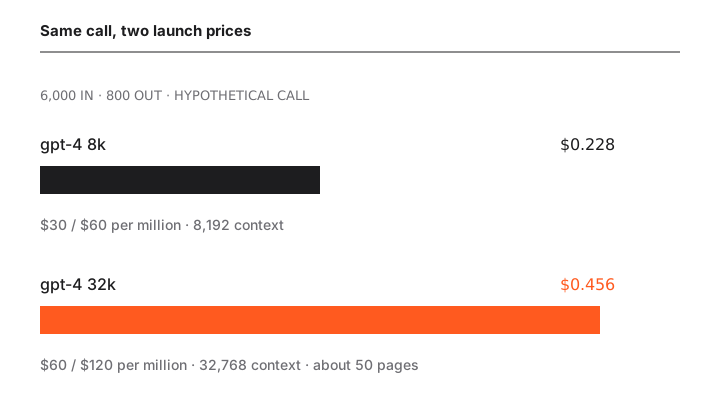
About 50 pages is OpenAI’s description of gpt-4-32k. This call on that model is $0.456, on limited access, while long-context quality is still being improved. The public name gpt-4 is the 8,192-token model, at $0.228, with defaults of 40k tokens per minute and 200 requests per minute.
What does the system card admit?
The card’s opening names four risks. Convincing text that is subtly false. More adept illicit advice. Dual-use capability. Risky emergent behaviors. Mitigations change the model’s behavior and block some misuse. The card says those mitigations remain limited and brittle.
The comparison inside the card is GPT-4-early against GPT-4-launch. Early is instruction-tuned, with fewer mitigations. Launch is the checkpoint this week’s API is aimed at. I would want a demo labeled with which of the two produced the answer. Early is the model before this round of mitigations. Launch is the model after the six months of alignment.
Two capabilities are out of scope. Custom fine-tuning is out of scope. Image capabilities are out of scope. Image inputs are the gap I would not skip. The research post says the model takes images and returns text. The API offers image inputs in a limited alpha. A screenshot or a scanned page is an image, and it sits outside the evaluation published this week. I would keep a pilot on text until an evaluation covers the input I mean to send. The text risks are the ones in writing. The rates above are the ones I can price.
The card dates the end of training to August 2022. That is the cutoff I would write on a review. The six months after it are alignment work: adversarial testing, and lessons from the ChatGPT preview. Alignment changes behavior. The date training finished remains August 2022.
What did six months of alignment leave in place?
OpenAI calls the result the best yet on factuality, steerability, and staying inside guardrails, “though far from perfect.” Best yet is against their earlier models, including GPT-3.5 around the bottom 10% of the simulated bar exam. The research post also says the model is less capable than humans in many real-world settings, and human-level on various professional and academic benchmarks. Anyone quoting the top 10% should carry those sentences with it.
I would test the residual the way the November preview already framed it. I would ask one question two ways, because ChatGPT was sensitive to phrasing and tended to guess instead of asking a clarifying question. I would look for convincing text that is subtly false, the card’s name for plausible-sounding incorrect answers. Steerability is the claim that the model can be pointed more reliably. Brittle is the card’s word for the mitigations. Illicit advice, dual-use capability, and risky emergent behaviors are the other names in the opening: a more capable model is more useful on both sides of a policy, mitigations block some of that misuse, and the block stays limited and brittle. I would score a sample on internal text against that sentence, with a person reading. The percentile is OpenAI’s benchmark. The sample is the acceptance test.
What would I measure before a prompt leaves?
GitHub Copilot for Business arrived on 7 December 2022 at $19 per user per month: license management, an org-wide policy including the public-code setting, and a no-retention commitment for code snippets. GPT-4 is a per-token API. The prompt goes to OpenAI. The 8k defaults are 40k tokens per minute and 200 requests per minute. I would write down which text may be sent, and which model name may receive it, before the percentile enters the review.
- The snapshot. Pin
gpt-4-0314. The aliasgpt-4moves when the recommended snapshot moves. Support for the pin runs until 14 June 2023. - The window. Default to 8,192 tokens at $30 and $60 per million. Treat 32,768 tokens, about 50 pages, at $60 and $120 per million, as a separate approval: limited access, quality still being improved, double the rate.
- The boundary. Text risks are in the card. Images and custom fine-tuning are out of scope, including when the limited alpha accepts a file.
- The residual. Factuality, steerability, and guardrails, far from perfect. Price a sample with the hypothetical call: $0.228 or $0.456, and $228 or $456 per thousand calls.
What I would do
I would join the text waitlist and leave the image alpha alone until a system card covers image inputs. I would pin gpt-4-0314 for any comparison I want to rerun before 14 June 2023, and keep gpt-4-32k-0314 off the default path. About 50 pages is a capacity description. The double rate, and the sentence that long-context quality is still being improved, are the approval I would require beside it.
I would write the checks from the card. Is the answer subtly false in a way that sounds finished. Does the guardrail hold when the wording changes. Is there a plan for mitigations that fail in a brittle way. The six months of alignment are why GPT-4-launch differs from GPT-4-early. I would leave “though far from perfect” in the pilot note, next to the ChatGPT limits. The free dialogue box is the November 2022 preview. GPT-4 access on this date is the waitlist.
The prices, the snapshots, the bar exam, and the six months of alignment are OpenAI’s research post of 14 March 2023. The risks, GPT-4-early versus GPT-4-launch, the August 2022 training date, and the out-of-scope line on images and custom fine-tuning are the system card.
Update, 29 October 2026
The $30 and $60 rates, and the double rate on the 32,768-token model, are the 14 March 2023 launch post. GPT-4o pricing is where I later priced a flagship call against this launch. How a window of 8,192 or 32,768 tokens fills in practice is in what a context window is. How text becomes the units those prices multiply is in what tokens are. I would read both before treating a March 2023 per-token quote as a current invoice.