GitHub Copilot for Business: the $19 seat and the privacy clause
Copilot for Business launched 7 December 2022 at $19 per user. What the no-retention clause covers, what the 55% claim measures, and a seat-price script.
GitHub Copilot for Business launched on December 7, 2022 at $19 per user per month. Individual Copilot had been on sale since June 21 at $10 a month or $100 a year. I read the new $19 as the price of a retention sentence and an admin switch. Suggestions were already for sale. The business post is where GitHub says an admin can force a setting, and what it will do with the code the editor can see.
A week earlier, the ChatGPT research preview shipped a free box and a printed list of limits. This launch ships a price. From a privacy and data-platform seat, the habit is the same. The sentence they were willing to print is the acceptance criterion. A performance claim is something I re-measure on a repository I am allowed to send.
What was already on sale to one developer?
The June 21, 2022 changelog is the individual price. Copilot costs $10 USD a month or $100 USD a year. It is free for verified students, and free for maintainers of popular open source projects. Technical preview users keep free access until August 22, 2022.
By December 7 that window has closed. The individual price on the table is the June price. “Popular” stays GitHub’s word. The changelog does not define the cutoff, and I have no basis to comp a team of 20. The script below prices paid seats.
The retention sentence I can cite is the December one. The June note is a price.
What does the $19 seat add?
The December 7 post puts the business plan on these terms.
License management. Someone can hand a seat out and take it back. Completions sit in one person’s editor. The business SKU is the one that treats the headcount as an admin list.
Org-wide policy controls, including the public-code matching setting. An admin can enforce that setting for the organization, so it does not depend on each developer remembering to turn it on. The post names the setting. What the page sells is the power to enforce it.
The no-retention line. With Copilot for Business, GitHub said it would not retain code snippets, and would not store or share code, whether the data comes from public repositories, private repositories, repositories that are not on GitHub, or local files.
I read the $19 as the price of that clause and of the admin switch. The speed and synthesis lines in the same post are claims about GitHub Copilot, the product already sold to individuals. The new lines on the business page are the license list, the org-wide setting, and the retention sentence.
What does the no-retention sentence cover?
The coverage is the list of origins. The assistant sees the file you have open. That file may be a public repository, a private repository, a repository that is not on GitHub, or a local file that is not a repository at all: a scratch buffer, a query pasted to reproduce a bug, a note on the desktop.
The origin I would paste into an approval note is the local file, read next to the non-GitHub repository. Customer text lands in repro scripts, fixtures, and files that never had a remote. This sentence includes those files, along with public and private GitHub repositories. Snippets and code, storing and sharing, across every origin the sentence names. That is the clause I would paste into an approval note.
License management and the public-code setting sit beside it. A retention rule an admin can assign, and a matching setting an admin can force, is what the $19 prices.
What do the 40% and 55% claims measure?
GitHub makes the reach claim and the two research claims in the same post. They answer different questions, so I would keep them on separate lines.
The reach line: Copilot “helped redefine productivity for more than a million developers.” That measures scale. A lot of people have used the product. It says nothing about a task I can repeat.
The synthesis line: “GitHub Copilot synthesizes up to 40% of code.” That measures a share of code. “Up to” is a ceiling they stated. The post names no language and no repository, so the ceiling stays a ceiling.
The speed line: “in research, we’ve found that GitHub Copilot helps people code 55% faster.” That measures speed, attributed to research. Sample size, language, and task are not in the post, so they stay out. The 55% becomes a number I can use after I time a task I can describe.
The synthesis line is about how much of the code the product writes. The speed line is about how fast a person finishes. I would tag each as GitHub’s claim, and I would keep a separate line for the decision they leave to the buyer: whether this repository is one we are allowed to send. Suggestions can exist on a repository the team is not allowed to transmit. The retention sentence sits next to the suggestions. Which trees may be opened with Copilot on is still a file-by-file decision.
The measurement I would run is a task I can define, timed with suggestions and timed without, on code I already know I may send. The 40% and the 55% stay in the vendor column until that timing exists.
Who is quoted, and what is that quote for?
Color, via GitHub’s post, kept out of the evidence column.
Shawn Wang of Airbyte, as quoted there, calls it a 2x and says he can’t live without it. A 2x in a launch post is a compliment. It stays out of the cell that holds the research line. The task I time is one I define. “Can’t live without it” is a preference, and a launch post is where preferences collect.
The post includes Feross Aboukhadijeh of Socket among the customers it quotes. His name is the color I have.
Mike Krieger is quoted on a nuance in JavaScript object comparison. A user noticed the product on a language detail. I would check object comparison on code I am allowed to open, and I would leave his remark as one observation relayed by the vendor, separate from the 55% line.
A tool people praise is a tool they leave on. Leaving it on is the moment the file can leave the machine. The quote and the clause belong in the same review, with the clause first.
What does a team of 20 pay?
The prices are the June and December list prices. The team of 20 is the diagram’s comparison, so the premium is one annual number. Arithmetic only. No packages, no network, no API key.
# copilot_seats.py — Python 3, no dependencies.
# Individuals: $10/month or $100/year (GitHub, 21 June 2022).
# Copilot for Business: $19/user/month (GitHub, 7 December 2022).
INDIVIDUAL_MONTH = 10
INDIVIDUAL_YEAR = 100
BUSINESS_MONTH = 19
TEAM = 20

def year(monthly):
    return monthly * 12

print(f"individual, monthly plan     ${year(INDIVIDUAL_MONTH):>5}/year")
print(f"individual, annual plan      ${INDIVIDUAL_YEAR:>5}/year")
print(f"business                     ${year(BUSINESS_MONTH):>5}/user/year")
print()
print(f"team of {TEAM}, individual annual   ${TEAM * INDIVIDUAL_YEAR:>5}/year")
print(f"team of {TEAM}, business            ${TEAM * year(BUSINESS_MONTH):>5}/year")
print(f"business premium for the team       ${TEAM * year(BUSINESS_MONTH) - TEAM * INDIVIDUAL_YEAR:>5}/year")
Output (Python 3):
individual, monthly plan     $  120/year
individual, annual plan      $  100/year
business                     $  228/user/year

team of 20, individual annual   $ 2000/year
team of 20, business            $ 4560/year
business premium for the team       $ 2560/year
One seat on the monthly individual plan is $120 over a year. The annual individual plan is $100 a year. Business is $19 a user a month, $228 a user a year.
For a team of 20, the annual individual column is $2,000 a year and the business column is $4,560. The difference is $2,560 a year, which is the diagram’s footer: business costs $2,560 more than the annual individual plan for this team.
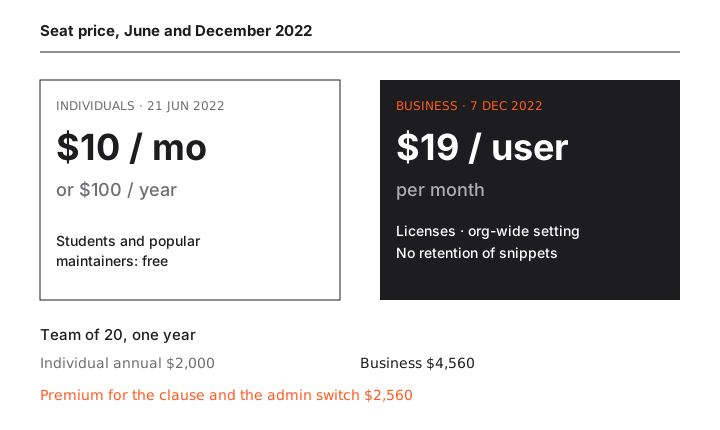
The $2,560 is what this team pays, above the annual individual plan, for license management, the org-wide public-code setting, and the no-retention line. The script applies no student or popular-maintainer discount. Those are individual terms. The technical preview is already over: free access there ended on August 22, 2022.
A “$10 a month” quote is one individual seat, $120 a year. Twenty business seats are $4,560. The number to justify is the $2,560 premium: the clause and the admin switch, on the repositories you have.
Sources
- GitHub, GitHub Copilot is generally available for businesses, December 7, 2022
- GitHub Changelog, GitHub Copilot is now available to individual developers, June 21, 2022
- This site, ChatGPT research preview, November 30, 2022
What I would do
I would separate “suggestions exist” from “we are allowed to send this repository.” Permission comes before the purchase. The $19 seat buys the retention clause, license management, and an org-wide public-code setting. I would write the clause, the license list, and the setting into the request, and I would copy the origins from the sentence: public repositories, private repositories, repositories that are not on GitHub, and local files.
I would price a team of 20 on the annual individual line and the business line the script prints. $2,000 a year is the annual individual plan. $4,560 a year is business. $2,560 is the premium to justify, and the justification is the clause and the switch. The 55% speed claim stays in the vendor column until I time a task I defined, on code I am allowed to send. Shawn Wang’s 2x stays a quote.
If the repository holds customer data, or the logic that enforces a privacy rule, I re-read those origins before I re-read the percentages. The file that matters is often the local one.
Update, 29 October 2026
The seat question outlived the 2022 price. When several coding agents edit one repository, suggestions can exist and the repository can still be one you are not allowed to send. I wrote about agents sharing a repo through separate working directories in git worktrees for parallel agents. A later coding model with a published token price is a different bill from a per-seat subscription. That comparison starts in Claude 3.5 Sonnet. The $19, the origins in the retention sentence, and the $2,560 premium here stay the December 2022 terms.