DeepSeek R1: MIT-licensed reasoning at $0.55 per million tokens
DeepSeek released R1 on 20 January 2025 under MIT, at $0.55 per million input tokens, with 79.8% on AIME 2024. What that does to a reasoning-search bill.
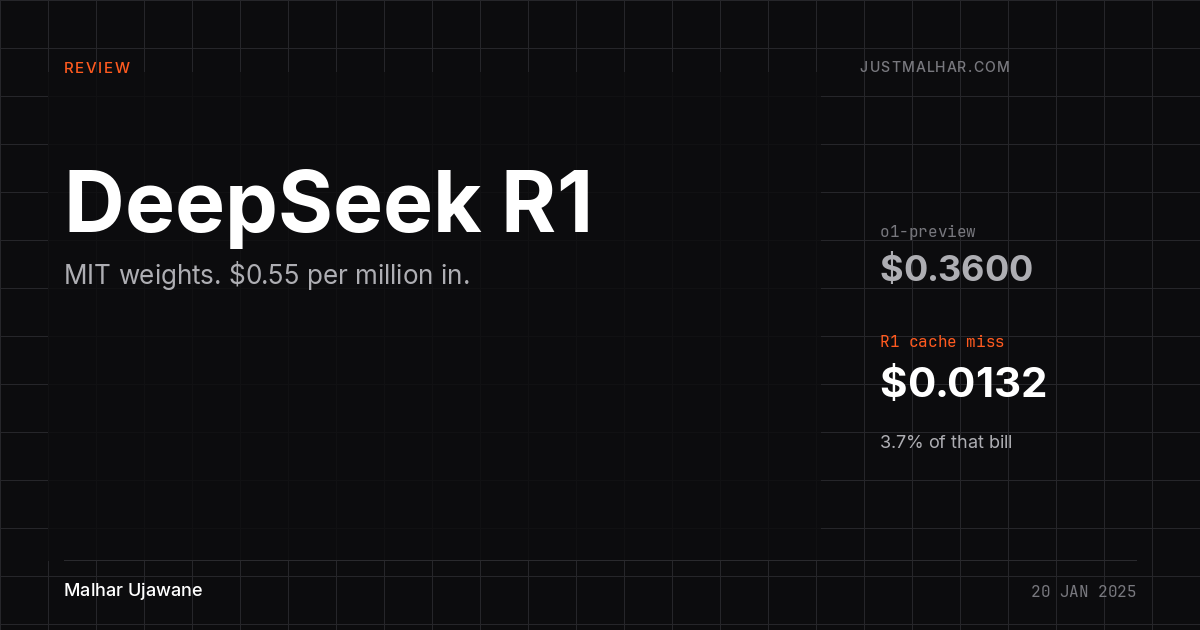
DeepSeek released R1 on 20 January 2025. The English announcement says its performance is on par with OpenAI o1. The weights and the code are under MIT. The announcement says you can distill them and commercialize them. The API is live the same day, as deepseek-reasoner, at $0.14 per million input tokens on a cache hit, $0.55 per million on a cache miss, and $2.19 per million output tokens.
Two other sentences in that post belong in the same first read. Six smaller distilled models ship with R1, and the 32B and 70B are described as on par with OpenAI o1-mini. API outputs may be used for fine-tuning and distillation. I would hold “on par” up against the paper’s table before I repeated it, and I would hold the MIT line up against each distill’s upstream license before I treated the smaller files as the same grant as R1.
The pair I care about, building a search product, is AIME 2024 at 79.8% and SimpleQA at 30.1%. The contest score says the reasoning is real. The factual score says retrieval still has a job. Reasoning does not replace the index.
What did the 20 January announcements include?
The Chinese announcement the same day prices the domestic API in yuan: 1 yuan per million input tokens on a cache hit, 4 yuan per million on a cache miss, and 16 yuan per million output tokens. The site and the app gain a DeepThink toggle. The yuan card and the dollar card stay separate.
The paper holds the architecture and the table. I am using the v1 table. R1 is a mixture-of-experts model, 671 billion parameters in total, 37 billion activated. Max generation is 32,768 tokens. For the sampling benchmarks the paper states temperature 0.6, top-p 0.95, 64 samples, reported as pass@1. That is the recipe I would use to stand next to a pass@1 number from the table.
What does the same reasoning-sized call cost?
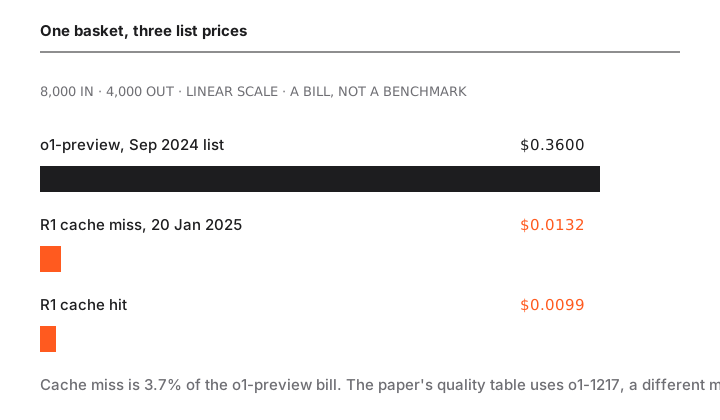
The bill uses the basket from the o1-preview note: 8,000 input tokens and 4,000 output tokens, a made-up call large enough that output matters. The o1-preview row is the September 2024 list price, $15 and $60 per million, as TechCrunch reported it on 12 September 2024. That row is a list price. OpenAI o1-1217 is the comparison model in the paper’s table, and it is a different name. The chart is a bill.
# r1_price.py — Python 3, no dependencies.
# o1-preview: $15 / $60 per million, TechCrunch, 12 September 2024.
# R1: $0.55 cache miss, $0.14 cache hit, $2.19 output, DeepSeek, 20 January 2025.
BASKET_IN, BASKET_OUT = 8_000, 4_000
models = {
    "o1-preview (Sep 2024 list)": (15, 60),
    "DeepSeek R1 cache miss": (0.55, 2.19),
    "DeepSeek R1 cache hit": (0.14, 2.19),
}
base = None
for name, (pin, pout) in models.items():
    usd = BASKET_IN * pin / 1e6 + BASKET_OUT * pout / 1e6
    if base is None:
        base = usd
    print(f"{name:<28} ${usd:.4f}   {usd / base:.1%} of o1-preview")
Output (Python 3):
o1-preview (Sep 2024 list)   $0.3600   100.0% of o1-preview
DeepSeek R1 cache miss       $0.0132   3.7% of o1-preview
DeepSeek R1 cache hit        $0.0099   2.7% of o1-preview
On this basket the September 2024 o1-preview list price is $0.3600. R1 on a cache miss is $0.0132, 3.7% of that bill. R1 on a cache hit is $0.0099, 2.7% of that bill. Output is $2.19 per million in both R1 rows, so the gap between hit and miss is the input side, $0.55 against $0.14. The script treats the whole 8,000 as either a miss or a hit. A real call is often a mix.
GPT-4o at the May 2024 rates of $5 and $15 per million is the other closed price from that spring. It stays out of this script. The script compares R1’s January API with the September 2024 o1-preview list price. The quality table uses other model names.
Where does the v1 table put R1 against o1-1217?
The comparison column is OpenAI o1-1217, except where the table adds another system. These are the rows I am willing to cite, with the metric written on the row:
- AIME 2024, pass@1. R1 79.8, o1-1217 79.2.
- MATH-500, pass@1. R1 97.3, o1-1217 96.4.
- Codeforces rating. R1 2029, the 96.3 percentile. o1-1217 2061, the 96.6 percentile.
- SWE-bench Verified. R1 49.2, o1-1217 48.9, Claude 3.5 Sonnet-1022 50.8.
- GPQA Diamond. R1 71.5, o1-1217 75.7.
- MMLU, pass@1. R1 90.8, o1-1217 91.8.
- SimpleQA, correct. R1 30.1, o1-1217 47.0, GPT-4o 0513 38.2.
- LiveCodeBench, pass@1. R1 65.9, o1-1217 63.4.
“On par with OpenAI o1” is DeepSeek’s summary sentence. The bullets are the finer print: contest math and LiveCodeBench favor R1 on these rows, while Codeforces, GPQA Diamond, and MMLU favor o1-1217. Claude 3.5 Sonnet-1022 at 50.8 on SWE-bench Verified is the paper’s third column on that row, ahead of R1 and o1-1217. That 50.8 is a SWE-bench Verified figure, a different eval from the internal coding score in the June 2024 Sonnet launch.
SimpleQA is the row I would keep beside AIME. R1 is correct 30.1% of the time, o1-1217 47.0%, and GPT-4o 0513 38.2%. The 38.2 is the paper’s figure for that dated snapshot. The GPT-4o note is the May launch price and does not contain it. A model at 79.8% on AIME 2024 can still miss short factual questions often enough that 30.1% is the operating number for a search box. A reasoning trace is a weak stand-in for a retrieved page when the question is a fact.
The paper’s sampling benchmarks use temperature 0.6, top-p 0.95, 64 samples, and pass@1. Max generation is 32,768. The checkpoint is 671 billion parameters total and 37 billion activated. Activated parameters describe a forward pass. The file you store and license is the full model.
Which license covers the file you download?
The R1 repository and the R1 weights are MIT. That is the license on the model the announcement says you may distill and commercialize, and it matches the API term that outputs may be used for fine-tuning and distillation. For the full R1 checkpoint, MIT is the grant I would write in a review.
The six smaller models need a second line each. A distill carries the base model’s license with it.
The Qwen distills, at 1.5B, 7B, 14B, and 32B, descend from Apache-2.0 Qwen 2.5 weights and were fine-tuned on 800k R1 samples. Apache-2.0 still applies to those four. Distill-Llama-8B descends from Llama 3.1 8B. Distill-Llama-70B descends from Llama 3.3 70B Instruct. Those Llama licenses still apply. The 800k figure belongs to the Qwen fine-tune. It does not describe the Llama distills, and it does not rewrite either upstream grant.
Llama 2, from 18 July 2023, is the contrast. A licensee whose products had more than 700 million monthly active users on the Llama 2 release date had to request a license, which Meta could grant or not. That license also barred using the materials or their outputs to improve any other large language model, excluding Llama 2 and derivative works. R1’s weights are MIT, and the January announcement allows API outputs for fine-tuning and distillation. The announcement’s “32B and 70B on par with o1-mini” line is a quality claim. The license on a 32B Qwen file is still Apache-2.0, and the license on the 70B Llama distill is still the Llama license it descends from.
What can a search product do with this price?
rSearch, which I was already building, is the kind of product this price and this license were for. A search product can put a reasoning model in the path. On a cache miss, the basket in the script is $0.0132, 3.7% of the September 2024 o1-preview list price for the same token counts.
SimpleQA at 30.1% is why that path still has retrieval. Reasoning does not replace the index. A search product can retrieve first and ask the model to work over what came back. I want a source sitting next to the claim, and $0.0132 on this cache-miss basket is what makes that order affordable. MIT on the R1 weights, plus permission to distill, commercialize, and train on API outputs, means the checkpoint does not come with Llama 2’s 700-million-user request. A domestic account uses the other card from the same day: 1 yuan, 4 yuan, and 16 yuan per million, with DeepThink on the site and the app.
What I would do
I would call deepseek-reasoner, and I would log cache hit against cache miss: $0.14 versus $0.55 per million on input, $0.0099 versus $0.0132 on this basket. I would label $0.3600 as the September 2024 o1-preview list price, and I would label 79.2 on AIME or 47.0 on SimpleQA as o1-1217. The 3.7% figure is a bill. The table is a set of scores against a different model id.
I would print SimpleQA’s 30.1% next to AIME’s 79.8% on any factual product and keep retrieval in front of the model. I would reproduce a pass@1 number only at temperature 0.6, top-p 0.95, and 64 samples, under the 32,768 cap. I would take MIT as the grant on the R1 weights, and I would read the Qwen or Llama upstream license before I served a distill. DeepSeek’s “on par with o1-mini” line for the 32B and 70B is their claim. I would run my own coding tasks before I bought on it.
Update, 29 October 2026
R1 became the core reasoning model in rSearch, which is what the work page records, with OpenAI and OpenRouter as well and Serper for retrieval.
Later open models kept moving the price. What reasoning models are covers the hidden-token bill as a general pattern. Kimi K3.1 Pro prices a later open model on that model’s own terms. What is sparse attention? is where a later DeepSeek architecture changes the cost of a long prompt. SimpleQA at 30.1% is still why retrieval stays in the path.