Claude Opus 4.5 effort parameter: what it does to cost
Claude Opus 4.5 costs $5/$25 per million tokens and adds a beta effort setting. How effort changes token spend and cost per task, with a runnable script.
Claude Opus 4.5 came out on November 24, 2025 at $5 per million input tokens and $25 per million output tokens, a third of what Opus 4.1 cost. It also ships a beta effort parameter that tells Claude how freely to spend tokens, and on agent workloads that one setting can move your bill more than the price cut.
What changed with Claude Opus 4.5?
For builders, the launch post and docs come down to four things:
- Price. $5 / $25 per million tokens, down from $15 / $75 for Opus 4.1 (August 2025). Sonnet 4.5 stays at $3 / $15 per the pricing page.
- Model ID
claude-opus-4-5-20251101, on the Claude API, the apps and all three major clouds. - An effort parameter, in beta, Opus 4.5 only, behind the header
effort-2025-11-24. - Context compaction and advanced tool use on the developer platform, plus a better Plan Mode in Claude Code, which deserve their own post.
What is the effort parameter?
Effort controls how eager Claude is to spend tokens on a response. Anthropic’s effort docs list three levels: high, medium and low. high is the default and behaves exactly like leaving the parameter out, so if you change nothing, you get maximum spend.
The useful detail is what it covers. Effort applies to every output token: the text, the tool calls and their arguments, and extended thinking when it’s on. It works with thinking turned off. At lower effort, the docs say Claude makes fewer tool calls, combines operations, skips the preamble and confirms tersely. A thinking budget caps one kind of token; effort changes the behavior behind all of them.
How much does Opus 4.5 cost per task?
Per token, Opus 4.5 is still 67% more expensive than Sonnet 4.5. Per task, Anthropic says it uses far fewer tokens. This script prices both claims. No key, no packages.
# effort_cost.py: what Claude Opus 4.5's price cut and effort levels do to output cost.
# Python 3, no dependencies, no API key.
# Prices: USD per 1M tokens, Anthropic pricing as of 24 Nov 2025.
PRICE = {"Opus 4.1": (15, 75), "Sonnet 4.5": (3, 15), "Opus 4.5": (5, 25)}

# 1. Same request on each model: 30k tokens in, 3k tokens out (a made-up but typical agent turn).
for model, (inp, out) in PRICE.items():
    usd = 30_000 * inp / 1e6 + 3_000 * out / 1e6
    print(f"{model:<11} ${usd:.3f} per turn   ${usd * 1_000:,.0f} per 1,000 turns")
print()

# 2. Anthropic's SWE-bench Verified claim, priced. Sonnet 4.5's output = 100 units.
#    Opus 4.5 at medium: matches Sonnet's best score with 76% fewer output tokens.
#    Opus 4.5 at high: beats it by 4.3 points with 48% fewer tokens.
sonnet = 100 * PRICE["Sonnet 4.5"][1]
for label, share in [("Sonnet 4.5 (best score)", 1.00),
                     ("Opus 4.5 effort=high", 1 - 0.48),
                     ("Opus 4.5 effort=medium", 1 - 0.76)]:
    model = "Sonnet 4.5" if label.startswith("Sonnet") else "Opus 4.5"
    usd = 100 * share * PRICE[model][1]
    print(f"{label:<24} {100 * share:>5.0f} tokens  output cost {usd / sonnet:>4.0%} of Sonnet's")
Output (Python 3.13.5):
Opus 4.1    $0.675 per turn   $675 per 1,000 turns
Sonnet 4.5  $0.135 per turn   $135 per 1,000 turns
Opus 4.5    $0.225 per turn   $225 per 1,000 turns

Sonnet 4.5 (best score)    100 tokens  output cost 100% of Sonnet's
Opus 4.5 effort=high        52 tokens  output cost  87% of Sonnet's
Opus 4.5 effort=medium      24 tokens  output cost  40% of Sonnet's
Part 1 is a hypothetical turn, the same tokens on every model, and it shows the plain price story: Opus 4.5 is a third of Opus 4.1 and still two-thirds more than Sonnet 4.5. Part 2 uses Anthropic’s own numbers from the launch post. At medium effort, Opus 4.5 matches Sonnet 4.5’s best SWE-bench Verified score “but uses 76% fewer output tokens”, which works out to 40% of Sonnet’s output cost. At high effort it scores 4.3 points higher “while using 48% fewer tokens” (the post says tokens there, without “output”), which prices out at 87%.
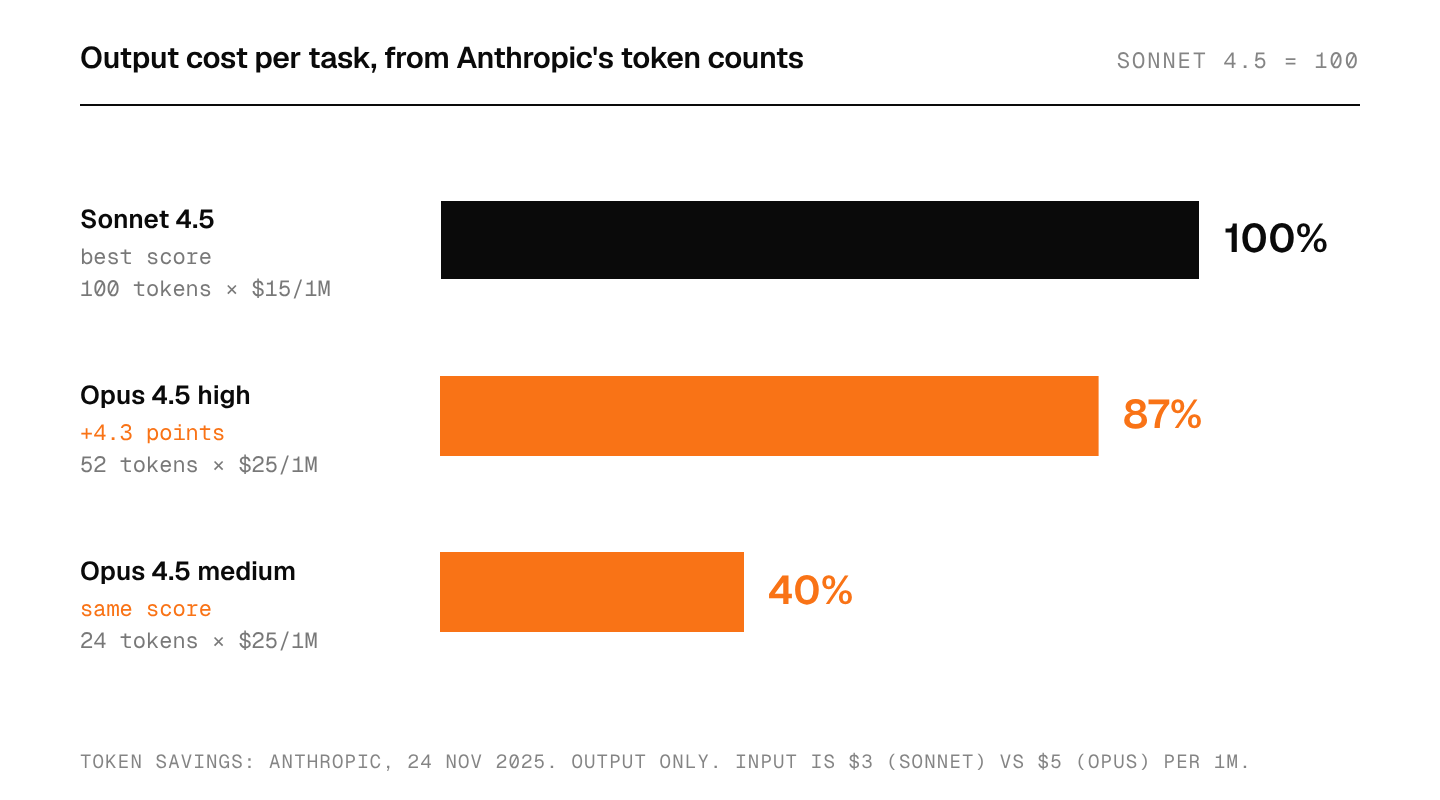
Read that chart with care. It’s one benchmark, Anthropic ran it, and it covers output only. Input costs $5 per million on Opus against $3 on Sonnet, and in an agent loop the input side grows every turn as the history gets resent, which I worked through for long prompts in what a context window is. Prompt caching softens that: cache reads on Opus 4.5 are $0.50 per million.
Setting effort is one field plus a beta flag. This is the request shape with the Python SDK; it needs a key, so there’s no output here:
# anthropic==0.75.0
import anthropic

client = anthropic.Anthropic()
resp = client.beta.messages.create(
    model="claude-opus-4-5-20251101",
    betas=["effort-2025-11-24"],
    max_tokens=4096,
    output_config={"effort": "medium"},   # "low", "medium" or "high" (default)
    messages=[{"role": "user", "content": "Find the off-by-one bug in this loop: ..."}],
)
print(resp.usage.output_tokens)
How does effort work?
Every token a model writes costs money and time, and a model on an agent task writes three kinds: its reasoning, its explanations to you, and its tool calls. Each tool call also adds a round trip, and the result comes back as input on the next turn. So a model that checks one more file or narrates one more step spends on both sides of the bill.
max_tokens is a hard cap: generation stops when it’s hit, whether or not the work is done. A thinking budget is a cap on one kind of token. Effort works differently. Anthropic describes it as how eager the model is to spend, a trained behavior that changes how much work it decides to do, so a low-effort Claude finishes the same task in fewer, terser steps instead of being cut off mid-way. That’s why it can save tokens without the truncation failures that low caps cause, which I showed for reasoning models in what reasoning models are.
When should you lower effort, and where does it break?
The docs suggest low for simple, high-volume work like classification, quick lookups and subagents, medium for agent tasks that need a balance, and high when quality is all that matters. As an opinion, I’d start Opus 4.5 agents at medium and only move up when an eval shows a task failing at that level.
Where it can bite:
- Quality drops on hard tasks. Anthropic says lower effort accepts “some reduction in capability”. The only way to know where your tasks land is to run your own evals at each level.
- It’s a beta. The header, the field and the behavior can change, and at launch it’s Opus 4.5 only, so keep it behind a model check if your code also calls Sonnet or Haiku.
- Cost per token hides cost per task. Compare models on total spend per solved task: input, output and retries. A cheaper model that needs two attempts costs more than an expensive one that needs one.
- Parallel attempts multiply everything. If you run best-of-N agents, like the git worktree setup I wrote about, effort savings and token waste both scale by N.
FAQ
Is Claude Opus 4.5 cheaper than Sonnet 4.5?
Per token, no: $5 / $25 against $3 / $15. Per task it can be, if Anthropic’s token savings hold on your workload. On their SWE-bench Verified numbers, Opus 4.5 at medium effort spends 40% of Sonnet’s output cost for the same score.
Does the effort parameter need extended thinking?
No. It works with thinking on or off. With thinking on, it shapes thinking tokens along with text and tool calls, and you can still set a thinking budget next to it.
What is the default effort level?
high. Sending "effort": "high" behaves the same as not sending the parameter at all.
Is effort the same as max_tokens?
They do different jobs. max_tokens cuts generation off at a fixed number; effort changes how much work Claude chooses to do before it finishes.
Sources
- Anthropic, Introducing Claude Opus 4.5, November 24, 2025
- Anthropic, Effort (beta docs, header
effort-2025-11-24), as of November 26, 2025 - Anthropic, Pricing, as of November 25, 2025
- Anthropic, Claude Opus 4.1, August 5, 2025